
01 USAGECLOUD CAPABILITY
High-Fidelity Data Mediation
High-fidelity usage data is the lifeblood of every digitally driven business introducing usage, outcome-based or any hybrid business models.
The problem is that the real world never provides that. Usage events are incomplete. Context is missing. Records arrive late, duplicated, or out of sequence. And every missing usage moment is missed revenue.
For that reason, usage data mediation is a must-have capability.
Raw Events In. Revenue-Ready Data Out.
AI monetization and the accelerated shift to usage and outcome-based models didn’t just change pricing. It changed the dependency on high-fidelity monetization data.
Unfortunately, the real world never provides that. Raw product or operational data is not revenue-ready. Events aren’t complete, validated, contextual, or finance-grade. Revenue-ready data has to be built.
That’s why High-Fidelity Data Mediation has become a must-have capability. Every usage moment now has financial value – Lose one, and you lose revenue.

What We Hear Every Day.
Engineering keeps fixing the foundation
Without data mediation, every new product and pricing change is an unnecessary engineering project.
45%
say they need a better data foundation to scale confidently
Research: State of AI Monetization 2026, DigitalRoute
Finance can’t trust the numbers
The new audit starts in ten days. Finance teams can’t tell which numbers in last month’s close were estimates.
50%
dedicate 4+ FTEs to usage-to-revenue remediation
Research: The Year Customers Audited the Invoice, DigitalRoute
Customers find the errors first
You launched a new pricing dimension last month. This week four disputes surfaced — misformatted events were silently dropped.
29%
say customer disputes detect issues
first
Research: The Year Customers Audited the Invoice, DigitalRoute

01
Our Solution
02
How Usage Data Becomes Revenue-Ready
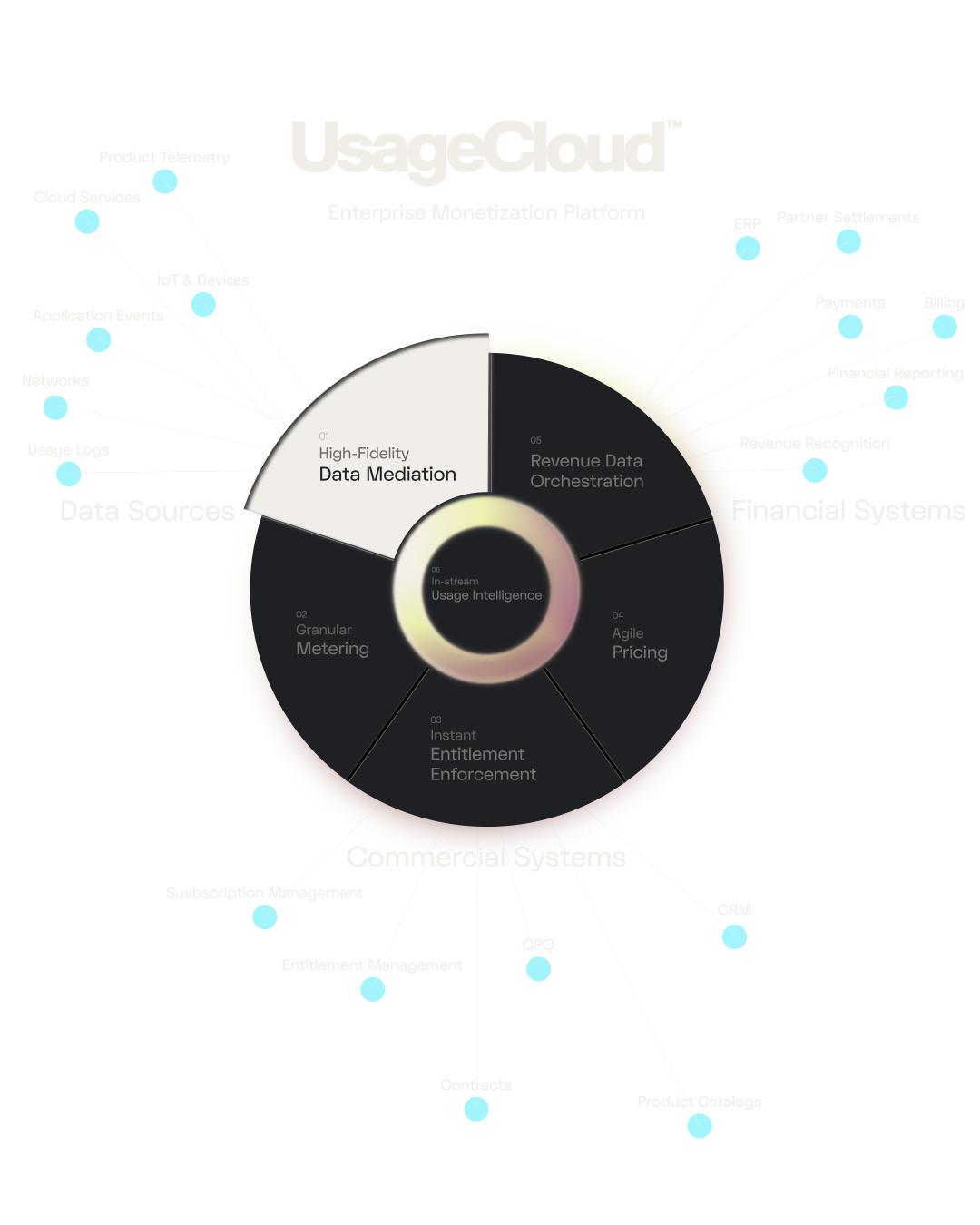
Real-time capture, decoding, and normalization of usage at the point of entry, with protocol- and format-specific collectors handling any source and any data format. Convert heterogeneous usage records into a unified, standardized data model, onboarding new formats through configuration, not custom parsers. From the moment usage enters the platform, downstream systems work from high-fidelity usage data trusted by billing, analytics, and finance.
Duplicates, schema mismatches, and incomplete records are detected in-stream, so each usage event is counted once — not missed, not billed twice. Deterministic fixes like deduplication and format conversion run automatically; ambiguous cases route into a review queue where operations inspect and correct them. Every correction and reprocess is logged, giving you a full audit trail for billing, finance, and compliance.
Business context bound to every record before any system downstream sees it. Identifiers like account, contract, product, and rate plan attach to every usage moment as it arrives, using lookups to CRM, catalogs, and reference data. Rule‑driven aggregation then correlates multiple usage moments from multiple sources into monetization‑ready records aligned with your pricing and reporting logic, so downstream billing, reconciliation, and audit always see the full, contextual picture.
03
What Defines High-Fidelity Data?
Usage Data Isn’t Born Revenue-Ready. It needs to be refined and made such. We define High-Fidelity monetization data to be complete, accurate, precise, granular, and trusted—ready to power every pricing decision, entitlement, invoice, forecast, and financial outcome.
It also scales to the realities of modern business: billions of events, real-time processing, and every product, service, and unit of value.
| Characteristic | Why It Matters for Monetization |
| Volume | Every usage event equals revenue. Billions of monetizable events must be processed reliably without loss. |
| Velocity | Value is created in real time. Data must be captured, validated, and available as events occur—not at month-end. |
| Variety | Data comes in various formats. High-fidelity data is composed from AI prompts, API calls, transactions, workflows, machine hours, streams, outcomes, credits, and more. |
| Veracity | Every event must be complete, accurate, validated, deduplicated, enriched, and fully traceable. Finance-grade trust starts here. |
| Value | Every usage moment can create revenue—or lose it. Monetization data must preserve the true business value of every event. |
| Precision | High-Fidelity data must be 100% correct. Customer, product, timestamp, quantity, cost, entitlement, and every business attribute must be accurate and reliable. Nothing wrong. |
| Granularity | High-Fidelity data is preserved individually. At product and customer level. Nothing averaged, aggregated, or lost before monetization. |
| Financial Integrity | Every monetization record must be traceable, auditable, and reconciliation-ready—trusted by finance from raw event to recognized revenue. Full data lineage. |
Let’s Find Your Monetization Data Gaps
Most companies collect a lot of data. Few know if it’s revenue-ready.
In a complimentary assessment, we’ll benchmark your current capabilities against the Eight Characteristics of High-Fidelity Monetization Data and show you exactly what to improve—and how.

What Changes?

The Data Mediation Advantage
Adding a new source becomes configuration, not engineering. Data quality issues surface at collection. Validation, correction, aggregation and enrichment all happen in-stream. Business context attaches the moment data arrives. Lineage is recorded as data flows, not reconstructed after.
Data mediation stops being a project. It becomes infrastructure, the system of record for the usage data everything else depends on.
01
For engineering — from maintenance to momentum
Stop owning brittle custom pipelines. Transaction safety and exactly-once semantics are guaranteed at the platform layer. APIs are AI-native, MCP-compatible, so agents can investigate data lineage alongside your team.
02
For product & pricing — from guesswork to confidence
New usage dimensions ship as configuration, not sprints. Pricing runs against accurate real-time data, not against approximations of what last month looked like. The model you can launch is no longer constrained by the model your data can support.
03
For finance — from fragmentation to financial truth
Every record on the invoice, in the GL, and in the revenue report originates from the same trusted source. Month-end stops being a manual reconciliation exercise. Audit responses are retrieved, not reconstructed.
Impact + Proof
400+ billion
Events processed per day for a single customer
5,000,000+
Records processed per second
3X
Faster time-to-operate with proven integration frameworks, tooling and expertise
90%
Reduced manual processing through work automation
30-40%
Lower TCO due to reduced engineering maintenance work
90%
Less revenue leakage
Zero
Audit breaches and disputes through full usage data lineage and auditability
MCP
MCP-compatible. Same workflow, same audit trail, whether driven by an engineer or an agent.