
O6 USAGECLOUD CapABILITY
Revenue Data Orchestration
The finance-grade layer between billing and financial close.
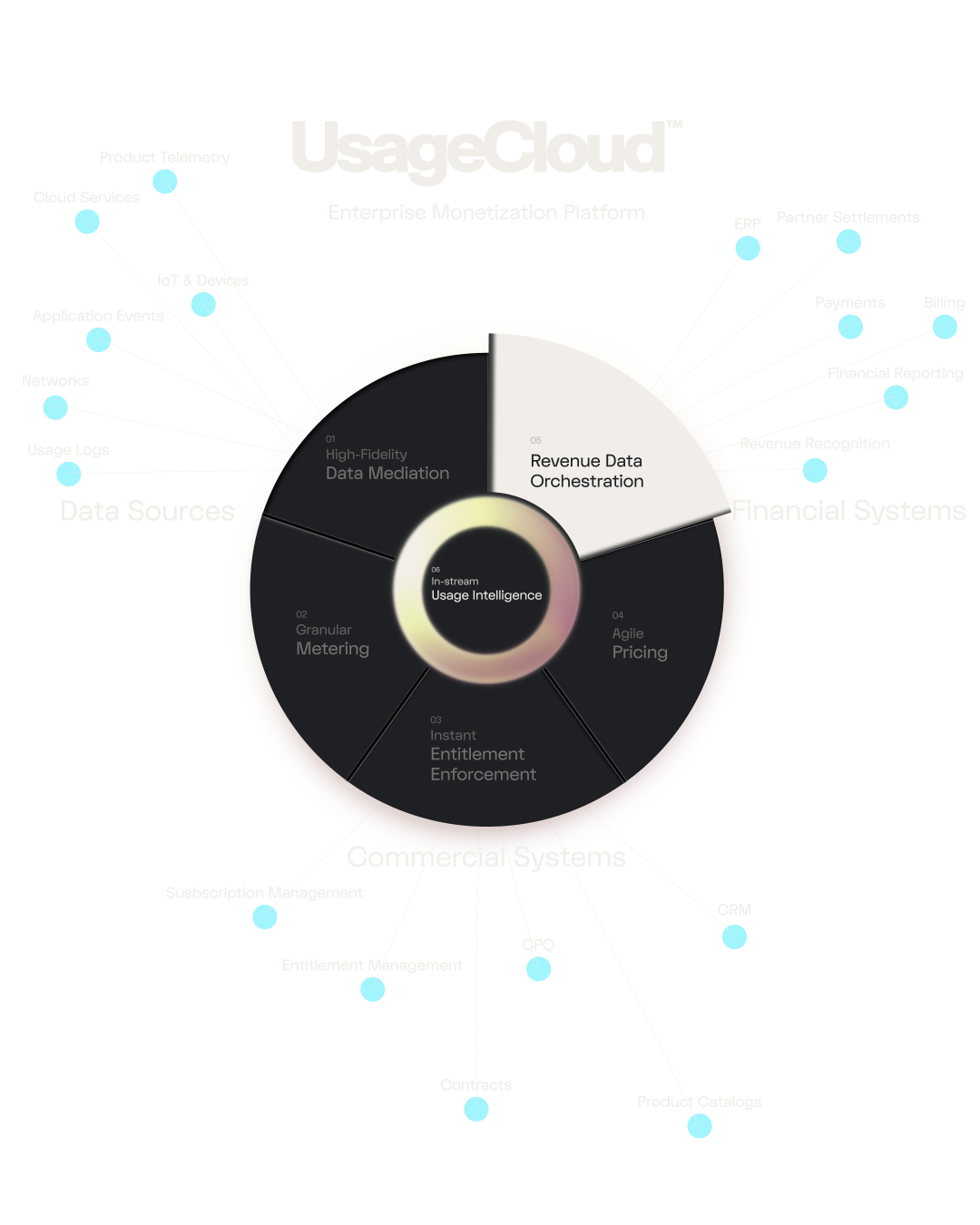
Built natively into UsageCloud, Revenue Data Orchestration continuously reconciles usage, pricing, entitlements, invoices, and commercial agreements into finance-grade revenue data. Power ERPs, revenue recognition, partner settlements, royalties, and financial close with one trusted commercial lineage—from data to dollars.
What You Can’t Reconcile, You Can’t Close
Most finance systems were built for much simpler monetization —not dynamic usage-, outcome-, and hybrid-based revenue. As commercial complexity grows, so do manual reconciliation, audit risk, compliance exposure, and customer disputes.
That’s why we built Revenue Data Orchestration into UsageCloud. A finance-grade revenue data layer between billing and financial close. It continuously powers reconciliation of usage, pricing, entitlements, billing, contracts, and partner data before sending a consolidated finance-grade revenue records to ERP, revenue recognition, settlements, royalties, and financial close.
Power Finance. Trust Every Dollar.

What We Hear Every Day.
Month-end Is a Reconciliation Mess.
Revenue data arrives fragmented across business units, products, billing systems, regions, and monetization models. Finance spends weeks consolidating and validating revenue before closing can begin.
50%
of finance teams spend four or more FTEs on manual revenue consolidation and reconciliation.
Research: The Year Customers Audited the invoice, DigitalRoute
Risk of Audit Breach Has Increased
Auditors ask one simple question: Why was this revenue recognized? Finance must reconstruct usage events, outcomes, pricing and rating, contracts, invoices, and revenue across multiple disconnected systems—often manually.
61%
Can’t produce finance-grade evidence without manual reconstruction.
Research: The Year Customers Audited the Invoice, DigitalRoute
Revenue Data Outgrows Our Financial Systems
Every product, new geography, partnering, and monetization model creates another stream of revenue data. Without automation, consolidation and mediation it sufficates the current financial systems.
55%
Say increased complexity and volume of revenue data is becoming an issue.
Research: The Year Customers Audited the Invoice, DigitalRoute
Revenue Data Orchestration Explained

01
UsageCloud™
02
How Revenue Data Orchestration Works?
Three functions. One continuous finance-grade revenue data consolidation.
Pricing was never designed to live in production applications or standalone tools. UsageCloud makes pricing a connected, decoupled platform capability—running on the same metered, high-fidelity usage data, live entitlement state, and commercial intelligence that powers the entire monetization flow. Built from the ground up for AI monetization and usage-, outcome-, -, and hybrid models.
Revenue data is continuously collected from fragmented billing systems, subscription management and payment systems, ERP, partner sources, locations and business units. UsageCloud validates, normalizes, enriches, and consolidates every revenue record into one finance-grade revenue dataset to be ready for reconciliation and closing—regardless of source.
Every revenue record is continuously reconciled against the complete commercial lineage—usage events, metering, entitlements, pricing, contracts, invoices, payments, credits, and adjustments. Discrepancies are detected automatically before they become audit findings, revenue leakage, or financial close delays.
Validated, audit-ready revenue data is continuously distributed to ERP, revenue recognition, accounting, partner settlement, royalty, reporting, and analytics systems. Every downstream process operates from the same finance-grade revenue truth—with complete commercial lineage, automated reconciliation, and audit-ready evidence for financial close and compliance.
03
Revenue Data Orchestration. Reimagined.
We believe entitlement enforcement should know everything, check everything, and trigger everything. Know the customer’s live entitlement state. Check every usage and outcome event against it. Trigger the right business action instantly. These three principles have guided how we’ve built UsageCloud for more than 25 years—and why it performs differently in the era of AI, usage, and outcome-based business models.
01 Decouple Commercial Logic. Completely.
Commercial innovation shouldn’t wait for engineering—and engineering shouldn’t carry commercial complexity. Pricing, packaging, customer-specific agreements, AI offers, and hybrid business models belong in a dedicated pricing capability, not production applications. Decoupling commercial logic breaks the cycle between commercial debt and technical debt.
02 Price on One Data. One Commercial Truth.
Pricing should never rely on disconnected systems or stale data. UsageCloud Pricing runs natively on the same high-fidelity usage data, metering, entitlement state, costs, and commercial context as the rest of the platform. Every pricing decision, rating, revenue, cost, and margin calculation is based on one trusted commercial truth—not assumptions or data copies.
03 Continuously Optimize with AI and Intelligence
Pricing shouldn’t be set and forgotten. AI and Usage Intelligence should continuously reveal changing customer behavior, commercial patterns, pricing opportunities, cost drivers, and margin impact. Every pricing decision is informed by evidence—not guesswork—so commercial models continuously improve as your business evolves.
So We Built Pricing Differently.
Traditional pricing software was designed for subscriptions and static price books. Modern monetization demands continuous commercial innovation driven by trusted usage data, intelligence, and financial precision. That’s why UsageCloud Pricing is built natively into the UsageCloud platform—sharing the same high-fidelity usage data, metering, entitlement state, costs, and commercial truth. The result is pricing that moves as fast as your business without sacrificing trust, compliance, or control.
01
Decoupled Commercial Logic
Commercial innovation without technical debt.
We decouple pricing from production. Commercial models can evolve continuously while engineering keeps production stable. Decoupling commercial logic breaks the cycle between commercial and technical debts.
02
Connected to one data and One Data. One Commercial Truth.
Every pricing decision starts with trusted data.
Unlike standalone pricing tools, UsageCloud Pricing runs on the same high-fidelity usage data, metering, entitlement state, costs, and commercial context. No silos, no room for errors. Revenue, cost, and margin are always calculated from one trusted commercial truth.
03
AI Intelligent & Headless UX
Intent-aware pricing. Trusted execution.
UsageCloud Pricing combines AI, Headless UX, MCP, and a live System of Usage Record, enabling pricing to be managed effective by teams and AI agents. People define the commercial intent. AI executes it—automating pricing operations and continuously optimizing commercial models using trusted usage intelligence.
04
Deterministic Rating
Every event. Correct rate. Every time.
Every usage event is rated against the exact pricing model effective at the moment it occurred. Rating decisions are consistent, repeatable, explainable, and fully deterministic—even when pricing models evolve or late events arrive.
05
Full Finance-grade lineage
Every number has a source and is audit ready
Every charge traces back to the original usage, pricing model, commercial agreement, and costs. Finance-grade lineage provides the evidence required for compliance, audits, revenue recognition, and customer disputes—without reconstruction or guesswork.
06
Enterprise Scale
Built for commercial complexity.
Having millions of customers. Billions of usage events. Unlimited pricing dimensions. UsageCloud is made for that scale and complexity. Without compromising performance, latency, or financial accuracy.

See Your Revenue Data Orchestration Delta
We understand sometimes it is hard to see abnd realize what’s available and what’s needed next? It is hard to spot the delta. Let us help you to compare your current pricing architecture, tooling, and processes against UsageCloud. We’ll identify what changes, what improves, and where you’ll unlock the biggest gains.

The Outcome. What Changes?

The Entitlement Enforcement Advantage.
Live entitlement enforcement is not just a way to change how products are defined and monetized it also fundamentally transforms how teams operate every day. Here’s what their new every day life looks like.
01
For engineering —
Decoupling commercial logic from production code
Pricing logic moves into a configurable pricing layer. Commercial changes no longer require engineering projects, usage pipeline rewrites, or production re-architecture. Commercial agility no longer creates technical debt—engineering gets back to building products.
02
For Product & Pricing — from guesswork to intelligent continuous optimization
Launch, test, and evolve any pricing model with speed and confidence. Decisioning is backed by real life usage data and cost, revenue, and margin intelligence—not assumptions. AI helps execute commercial intent and continuously identifies opportunities to improve pricing performance
03
For finance — Margin fragility to full control
Every rated charge is finance-grade, fully traceable, and audit-ready. Revenue, costs, margins, and pricing history always reconcile to the underlying usage and commercial model—giving Finance confidence instead of surprises.
Proofs of Impact.
Agile pricing changes how enterprises innovate, monetize, and operate. These are examples of measurable business outcomes our customers have achieved after moving pricing to UsageCloud.
6 Changes 0 Tickets
A customer introduced six AI monetization model changes in three months—without a single engineering project.
12% Higher Margin
Pricing driven by live usage intelligence increased gross margins by 12%..
32 countries, in 60 days
A global media company launched a new 100% usage-based pricing model across 32 countries in just 60 days.
From 15 to 5
A CTO reduced the engineering team supporting commercial changes from 15 people to just 5.
300% higher productivity
AI-assisted pricing made pricing teams three times more productive.
7× Fewer disputes
Invoice disputes dropped from 150 to 20 per month, enabling Finance to resolve issues independently.