
AI / SaaS
Your Next Revenue Model Isn’t the Challenge– The Next Ten Are.
AI and SaaS companies are evolving their revenue models faster than their revenue stacks can keep up. Token bundles, outcome pricing, commit drawdowns, hybrid plans—every new model creates Digital Value Moments your legacy stack was never designed to monetize. UsageCloud upgrades your existing revenue stack with the Enterprise Monetization Platform built for continuous commercial innovation.
UsageCloud upgrades your existing revenue stack with the Enterprise Monetization Platform built for continuous commercial innovation.

Where We Stand.
AI didn’t start the shift away from per-seat SaaS pricing. It exposed a model that was already under strain and gave buyers a reason to stop tolerating it. Three forces are converging, and each one alone would be manageable — together, they force a fundamental transformation.
01
AI Didn’t Break Pricing.
It Created Tokenomics.
For decades, software pricing relied on one assumption: serving one more customer cost almost nothing. AI changed that overnight. Every prompt, inference, agent action, and retrieval consumes compute that directly impacts margins.
Welcome to Tokenomics—the economics of tokens, credits, and AI consumption. Costs now fluctuate continuously, influenced by model providers, context windows, reasoning depth, and traffic patterns. Pricing can no longer ignore cost-to-serve.
Insight: Margin is no longer a finance metric. It’s a real-time commercial decision.
02
Customers No Longer Buy Access.
They Buy Digital Value of Usage and Outcomes
Seats, licenses, and subscriptions are becoming just one way to package value. Customers increasingly expect pricing to reflect what they actually consume and the outcomes they achieve. Every prompt, transaction, booking, stream, and API call becomes a Digital Value Moment—and every Digital Value Moment is an opportunity to create revenue.
Insight: Businesses no longer monetize software. They monetize digital value
03
Revenue Innovation Became Continuous.
Revenue Stacks Are Left Behind.
AI, pricing, bundles, credits, and packaging now evolve monthly—or even weekly. Yet most revenue stacks still expect quarterly releases and engineering projects for every commercial change. The competitive advantage is no longer the pricing model itself—it’s how quickly you can evolve it.
Insight: Revenue model agility requires revenue stack agility.
UsageCloud for AI Monetization

02
Enterprise Monetization Is a Team Sport
AI & SaaS Monetization Is a Team Sport
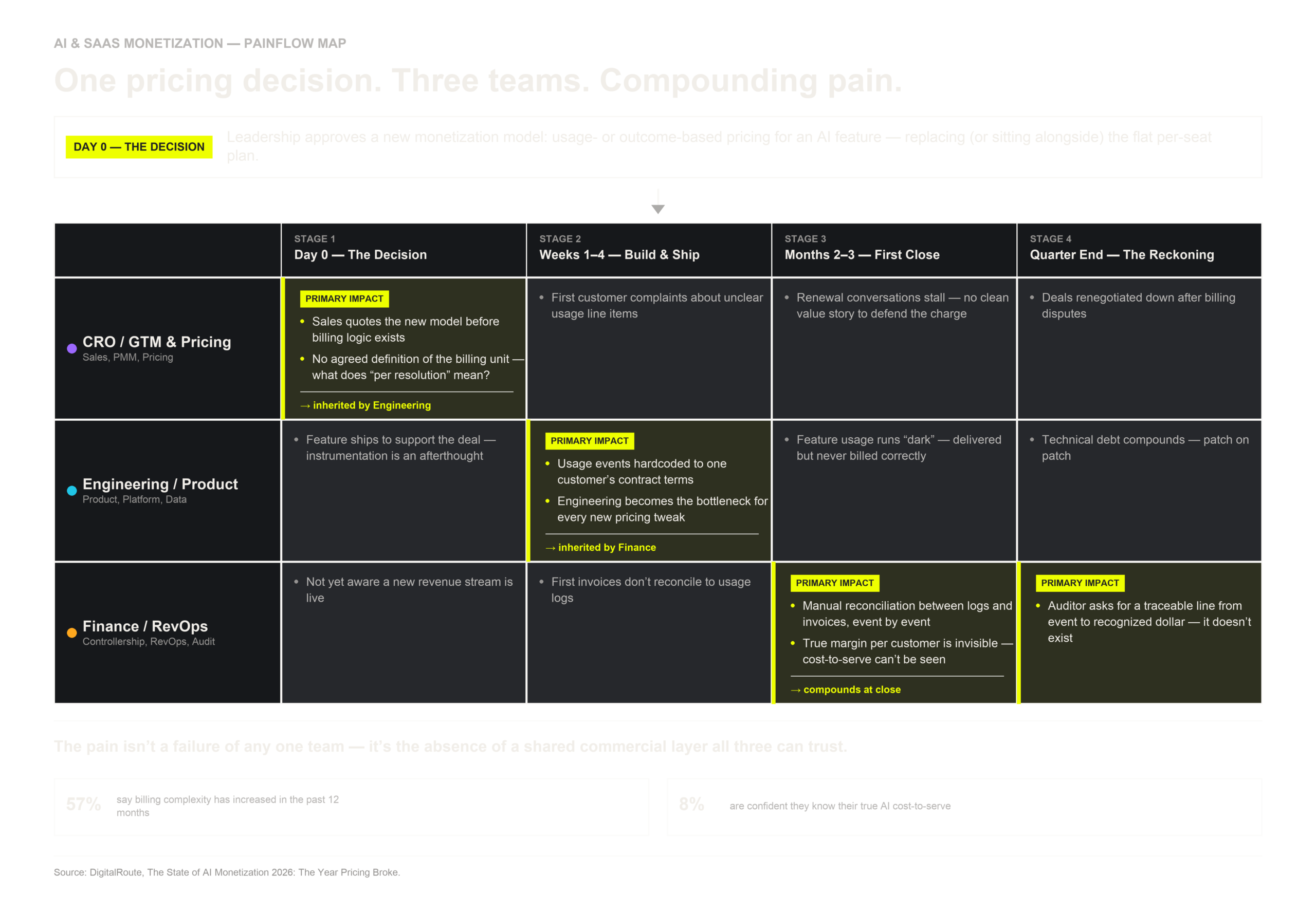
AI monetization doesn’t simply introduce tokens, credits, usage pricing, and hybrid plans—it creates Tokenomics: a new commercial operating model where every prompt, inference, API call, and customer interaction becomes both a product experience and a revenue event. Every new pricing experiment, AI model, customer-specific agreement, or outcome-based contract multiplies dependencies across Product, Engineering, and Finance.
The companies that scale AI successfully won’t have the smartest pricing. They’ll have the most agile revenue operating model.
Product
Commercial Innovation
Every AI feature, token bundle, usage metric, outcome guarantee, customer commitment, or pricing experiment creates new commercial rules.
AI credits expire. Token costs change. Models evolve. Customers negotiate exceptions. Promotions, entitlements, overages, regional pricing, and partner agreements quickly multiply.
Without the right monetization capabilities, innovation turns into Commercial Debt—complexity that slows every future product launch.
Engineering
Becomes Technical Debt
Engineering inherits every commercial decision.
Token accounting, usage metering, entitlements, AI model selection, pricing logic, billing, APIs, customer portals, contracts, and integrations become tightly coupled. Every pricing or packaging change becomes another engineering project instead of a commercial decision.
Your engineers should build AI products—not monetization infrastructure.
Finance
And it All Lands Here.
Eventually, the complexity reaches Finance.
Revenue leaks between systems. AI costs and customer revenue drift apart. Revenue recognition becomes harder. Reconciliation turns into a monthly fire drill. Forecasts lose accuracy. Invoice disputes increase. Audits become longer because every token, credit, and usage event must be traced back to trusted revenue.
When monetization loses trust, AI loses profitability.
03
So What?
What is the invisible cost of letting the commercial-technological- financial gaps widen? Enterprise Monetization doesn’t fail overnight. It fails one commercial decision at a time. Every missing capability creates friction. Together, they slow innovation, erode margins, and weaken trust across the business. Here’s some concrete and non-theoretical risks we see and hear every day in enterprises that a missing the new critical capabilities.
You Leave 5–15% of Revenue Behind
Revenue doesn’t disappear in one place.
It leaks through unmetered AI usage, incorrect entitlements, delayed pricing changes, billing exceptions, inaccurate rating, disputed invoices, and forgotten customer agreements. Individually they’re small. Together they become millions.
Industry research estimates 3–15% of enterprise revenue is typically lost through revenue leakage.
Competitors Monetize Before You Do
Launching an AI product is no longer enough.
The companies winning enterprise AI are the ones that package, price, and commercialize new value first. If every pricing change requires engineering projects and system updates, competitors capture willingness-to-pay while you’re still preparing the release.
Commercial speed has become competitive advantage.
Your Best AI Customers Become Your Least Profitable
AI doesn’t have fixed costs.
Inference costs, model providers, context windows, and reasoning depth change continuously. Without real-time profitability visibility, customer growth can quietly destroy margins before Finance even notices.
AI adoption without cost visibility becomes margin erosion.
Customers Buy Value—Not Access
Enterprise buyers no longer want one commercial model.
One customer wants prepaid credits. Another wants annual commits with monthly drawdowns. Others demand outcome pricing, spending caps, or hybrid contracts. Seat-based packaging increasingly turns renewal conversations into pricing negotiations.
Research: AI buyers increasingly expect pricing to reflect consumption and outcomes—not ownership or access.
Engineering Becomes Your Monetization Platform
Instead of building AI products, engineering maintains pricing logic.
Every commercial experiment becomes another API, another integration, another entitlement rule, another billing workflow. Innovation slows because product roadmaps become dependent on monetization infrastructure.
Your pricing roadmap starts moving at the speed of engineering.
Valuation Starts Following Monetization Maturity
Investors increasingly look beyond ARR. They want predictable margins. Revenue quality. Commercial agility. Forecast accuracy. Finance-grade controls.
The companies commanding premium valuations aren’t just growing faster—they’re proving they can monetize AI profitably and repeatedly.
The market rewards monetization maturity, not just product innovation.

04
What We See Works.
Don’t just optimize for a new pricing model. Build the new strategic capabilities to monetize whatever comes next.
The AI economy isn’t asking companies to choose a better pricing model. It’s asking them to build a better monetization capability. Here’s where we see most organizations getting it wrong—and what we’ve learned over 25 years of Enterprise Monetization.
| WHAT MOST THINK | WHAT WE SEE WORKS | WHY |
|---|---|---|
| “We need to choose between subscriptions, usage, or outcomes.” | Build for many revenue models—not one. | Tokens and credits won’t replace subscriptions. Usage won’t replace outcomes. The future of moentization is hybrid. Dynamic, living operating model. Commercial agility—not pricing choice—will determine who wins. |
| “Let’s define and plan our pricing and margins first.” | Start with usage data and customer value. | Pricing should follow evidence, not assumptions. High-fidelity usage data reveals how customers create value, what drives adoption, where margins disappear, and what they’re are willing to pay for. Observe first. Monetize second. Optimize continuously. |
| “We’ll just build it by ourselves and extend our current stack.” | Decouple and keep monetization independent from products. | Every pricing change shouldn’t become an engineering project. Decouple commercial logic from product code so Product, Engineering, and Finance can evolve independently while sharing the same Revenue Truth. |
| “Finance will reconcile and make it audit-ready later.” | Automate Closing on One Revenue Truth from Moment to Money. | Every Digital Value Moment should flow through one finance-grade lineage—from usage and entitlements to invoices, revenue recognition, settlements, and reporting. The closer revenue gets to real time, the more valuable trusted data becomes. |
| “We need a new billing system.” | Upgrade what´s missing in your revenue stack— Not billing. | Billing, ERP, invoicing, and revenue recognition already do their jobs well. What’s missing is the Enterprise Monetization layer between products and finance—usage data management, metering, entitlements, pricing & rating, revenue data orchestration, and monetization intelligence. Upgrade what you don’t have instead of replacing what already works. |
Research. Not Opinion.

More than 650 companies participated in the second edition of our State of AI Monetization research. The results speak for themselves.
23%
Only 23% of organizations say they can accurately forecast AI-related usage, costs, and revenue. Half consider themselves only somewhat accurate, while 27% struggle significantly or lack confidence altogether.
57%
Pricing complexity has increased for 57% of organizations over the past 12 months. Only 7% say it has become simpler.
76%
76% consider real-time usage data essential for AI monetization (47% say it’s critical and 29% important). Yet 38% admit that managing and operationalizing that data is one of their biggest challenges.
45%
45% say they need a stronger data foundation before they can confidently scale AI-driven revenue. Only 9% believe their current foundation is sufficient.
43%
43% report improvements in customer experience and retention. Yet an even larger share experienced rising billing complexity, greater forecasting challenges, and increasing pricing pressure.
The evidence is clear: commercial complexity is growing faster than customer value.
The State of AI Monetization 2026 Report : The Year Pricing Broke
Our second annual research tracks how AI and SaaS monetization is evolving—and where companies are pulling ahead or falling behind. Based on insights from 650+ organizations, discover the trends, benchmarks, and emerging best practices shaping the next era of Enterprise AI Monetization.
UsageCloud® Versus
Every AI/SaaS company facing this shift chooses one of three paths: build it, buy a point solution, or run on purpose-built Enterprise Monetization Platfrom. Only one survives the next ten models easily, not just the first one.
Homegrown wins the first sprint, loses the second. A script counts tokens, a table tracks entitlements, a job stitches together an invoice — free and fast, until outcome-based fees land on top and one script becomes three, owned by the one engineer who understands them. Rev-rec becomes a hand-audited spreadsheet. Cost-to-serve stays invisible. Not hypothetical: it’s why 57% say billing complexity has increased and 61% say forecasting has gotten harder in the past year alone. Homegrown fails at the second pricing model, the diligence data room, or the first audit question with no line back to the source event.
Point solutions solve the easy 40%. Metering, Billing solutions are great in what they were designed for. But they are usage data receivers. Leaving heavy lifting on delivering increasingly complicated, messy, incomplete and unstructured finance-grade usage data for you. They also stop at billing. Revenue data consolidation, reconciliation, recognition, settlements and close stay bolted on elsewhere — never their job. E2E Cost-to-serve is someone else’s dashboard, if it exists at all. You still integrate a second system to finish what the first one started.
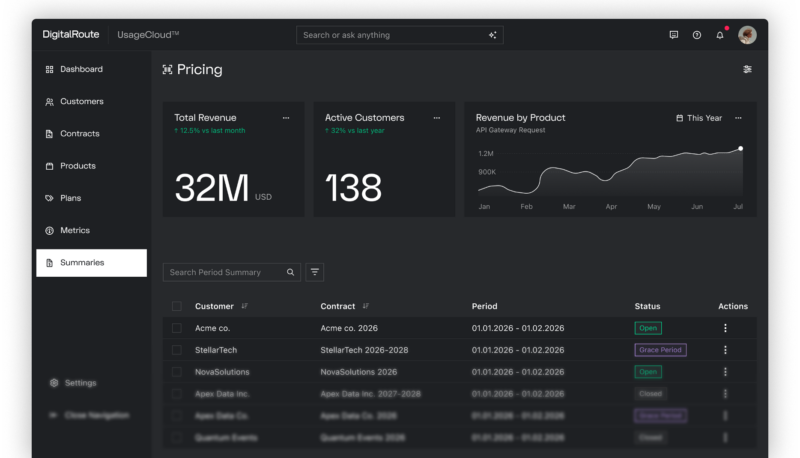
UsageCloud covers the whole distance. One system — mediation, entitlement, pricing, revenue data orchestration, and usage intelligence — runs from Digital Value Moment to recognized dollar. Model agnostic, so experiment two needs no new plumbing. Configure, not code, so PMM ships without an engineering ticket. Proven at telecom-grade volume since 2000, so token-level cardinality isn’t new to us. Rev-rec and audit traceability are native — the difference between One Revenue Truth and three spreadsheets that don’t agree.
| Capability | Homegrown | Point Solutions | Enterprise Monetization Platform |
|---|---|---|---|
| Time to ship a new pricing model | Weeks to quarters, eng backlog | Days — within the model it was built for | Days — configure, any model |
| Cost-to-serve / margin visibility | Rarely modeled until margin is gone | Out of scope — a separate FP&A exercise | Native, per-customer |
| Revenue recognition (ASC 606) | Manual, spreadsheet-driven | Bolted on via a second tool | Derived from the same event stream |
| Scale of Usage Data | Breaks under AI’s volume and cardinality | Built for SaaS scale, not token-level traffic | Trillions of events, telecom-grade |
| Who owns it when it breaks | One engineer — key-person risk | Your integration team, indefinitely | Our platform and partner ecosystem |
We don’t compete on billing, metering, entitlement or subscription management . We compete on Enterprise Monetization.