
Case Study · Software & Analytics
Modernizing Usage Data Infrastructure to Support a Business Model Transformation
Industry
Software & Analytics
Size
~8,000 employees
Region
Global
Monetization Model
Subscription + Usage-Based
About Customer
Use case
Consolidate Monetization Across Multiple Product Lines
Transformation
Perpetual Licensing → Subscription & Usage-Based
Live since
January 2021
Company
A publicly listed software company specialising in machine data analytics — helping organisations search, monitor, and analyse machine-generated data at scale. With thousands of enterprise customers globally and a product portfolio spanning free, enterprise, and cloud tiers, the company had built one of the most widely used data intelligence platforms in the market.
Situation
With over 20% annual growth and a deliberate strategic shift from perpetual software licensing to recurring subscription and usage-based revenue, the company’s existing ERP and billing systems had reached their ceiling. The architecture had been designed for a simpler, transaction-based world — not one where customers consumed software across multiple tiers, at increasing volumes, under constantly evolving pricing models. Both systems needed to change. The challenge was doing it simultaneously without disrupting a business growing too fast to slow down.
Challenges
The existing ERP had reached its limit. With revenue crossing $2B and accelerating, the platform could no longer handle the transaction volume, billing complexity, or pace of change the business demanded.- Both the ERP and billing system needed replacing at the same time. The two were too tightly coupled to modernize independently — creating a single high-stakes transformation with no fallback option if something went wrong mid-migration.
- The product portfolio — free, enterprise, and cloud tiers — each produced usage data in different formats. Bringing it together accurately required manual effort that was already struggling to keep up and would not survive further growth.
- Every new pricing model required engineering involvement to launch. Commercial teams could not test or iterate without opening a development ticket — slowing the business at exactly the moment it needed to move fast.
Why DigitalRoute
Legacy ERP vs. purpose-built – NetSuite billing replaced with a unified usage data mediation layer for SAP BRIM
At the scale and growth rate the company was operating at, building custom mediation infrastructure was not the right call — not because of the initial cost, but because every future pricing change would require re-engineering the data layer beneath it. A proven standard platform was the only option that could keep pace without becoming a maintenance burden.
- Proven at scale from day one. The platform handled the required event volumes out of the box — no custom tuning needed to reach production-grade throughput. For a business running a live ERP migration, a slow ramp-up was not acceptable.
- Commercial teams, not engineering, own pricing decisions. The platform’s architecture meant new pricing tiers and structures could be managed through configuration — removing engineering from a commercial workflow where it had become a bottleneck.
- Native SAP integration. With SAP BRIM as the target billing system, DigitalRoute’s existing integration removed a layer of connector work that would have added risk and timeline to an already complex migration.
The Solution
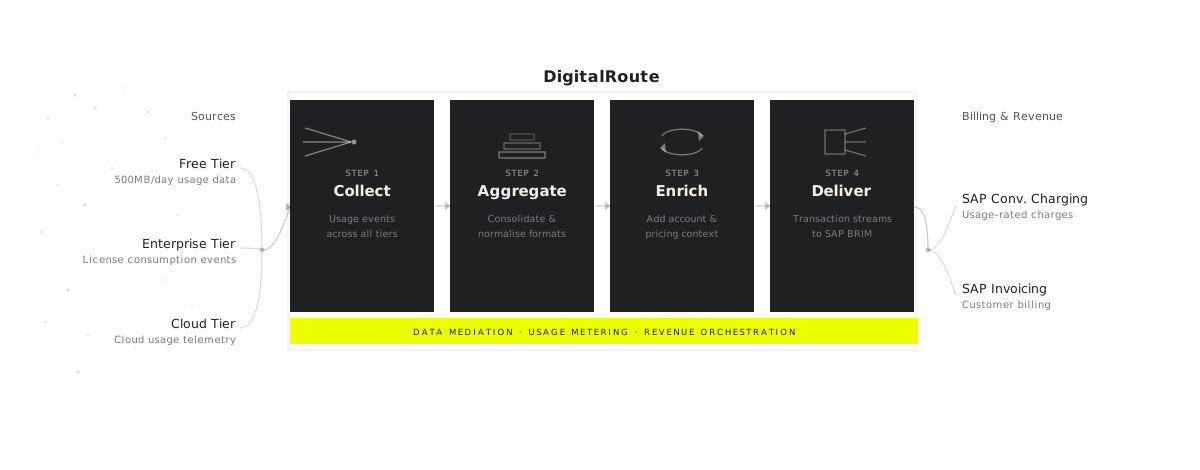
Data mediation layer between software product tiers and SAP BRIM
MediationZone was deployed as a common usage data platform across all product lines — Free, Enterprise, and Cloud — collecting and normalising usage events from each tier into a single, validated stream feeding SAP BRIM.
The bottleneck between commercial strategy and product launch was removed. Pricing structures that previously required engineering sprints could now be introduced, tested, and adjusted by the teams closest to the customer — without touching a line of code.
The simultaneous replacement of both ERP and billing system — one of the most complex monetization transformations in enterprise software — was completed with a shared usage data foundation underpinning both. The fragmentation that had made the old architecture impossible to scale was gone. a component that needs to be rebuilt for each new business model.
The Outcome
New pricing models launched without engineering
For the first time, commercial and product teams could introduce and iterate on subscription and usage-based tiers without opening a development ticket.
One platform across all product lines
A single, consistent usage data stream replaced fragmented, product-specific collection — covering every tier from free to enterprise to cloud.
Simultaneous ERP and billing modernization, completed
One of the most complex monetization transformations in enterprise software — replacing both systems at once — was delivered on a live, growing business.
The Architecture
Facing a similar challenge?
Talk to us for a walkthrough of how this transformation was done and what it could look like for your business.