
Case Study · Electric Mobility
Automating B2B Fleet Billing Across a Fast-Growing EV Charging Network
Industry
Electric Mobility
Size
~3,000 employees
Region
Europe
Monetization Model
Usage-Based + Subscription
About Customer
Use case
B2B Fleet & EV Charging Session Billing
Transformation
Manual Billing → Automated Usage Monetization
Live since
Q1 2024
Company
A global electric vehicle charging network operator — providing end-to-end charging solutions including hardware, software, and services to car manufacturers, fleet owners, enterprises, and consumers. Starting as a startup in 2015 and becoming a full subsidiary of a major energy company in 2017, the business had grown to over 300,000 charging points across more than 33 countries, with transaction volumes doubling year on year.
Situation
The growth trajectory was outpacing the billing infrastructure. Fleet operators — companies managing hundreds of vehicles and employees charging across the network — expected a single consolidated invoice covering both their card subscription fees and every charging session their employees completed. What had been manageable at lower volumes had become an operational constraint: manual billing processes could not keep pace with the 2x annual transaction growth, and the complexity of combining two distinct fee types into one accurate invoice had no automated solution.
Challenges
- Transaction volumes were doubling every year. Manual billing processes that had served the business at lower scale were breaking down — the team was processing more exceptions than invoices.
- Two fundamentally different fee types needed to appear on one invoice. Card subscription fees and per-session charging fees came from separate systems, in different formats, and with different billing cycles — reconciling them manually was error-prone and unsustainable.
- Duplicate charging session records arriving via Kafka had no systematic deduplication. Without a reliable filter, billing accuracy could not be guaranteed at scale.
- B2C and roaming partner billing were waiting behind B2B. Getting the automated foundation right for fleet invoicing was a prerequisite for expanding the model to consumer and third-party network roaming scenarios.
Why DigitalRoute
Manual vs. automated – fragmented session and card data replaced with a transaction-safe mediation layer for SAP S/4HANA
The implementation needed to go live in three months — on a platform already processing live fleet billing. There was no room for a long integration ramp-up, and the chosen approach had to drop into the existing SAP environment without re-platforming it.
- Transaction safety by design. For a billing system where every unprocessed session means a missed charge, automatic retries and zero data loss were non-negotiable. The platform’s Kafka-native collection ensured no session was dropped between ingestion and invoicing.
- Three-month go-live on RISE with SAP. The entire B2B billing layer was deployed and live within a quarter — a timeline only achievable because of pre-built SAP BRIM integration and a configuration-first implementation approach.
- Built to grow into B2C and roaming. The same mediation foundation that handled B2B fleet invoicing was architected to support consumer PAYG billing and multi-network roaming partner settlement in subsequent phases.
The Solution
Transaction mediation layer between Kafka charging data and SAP S/4HANA Convergent Invoicing
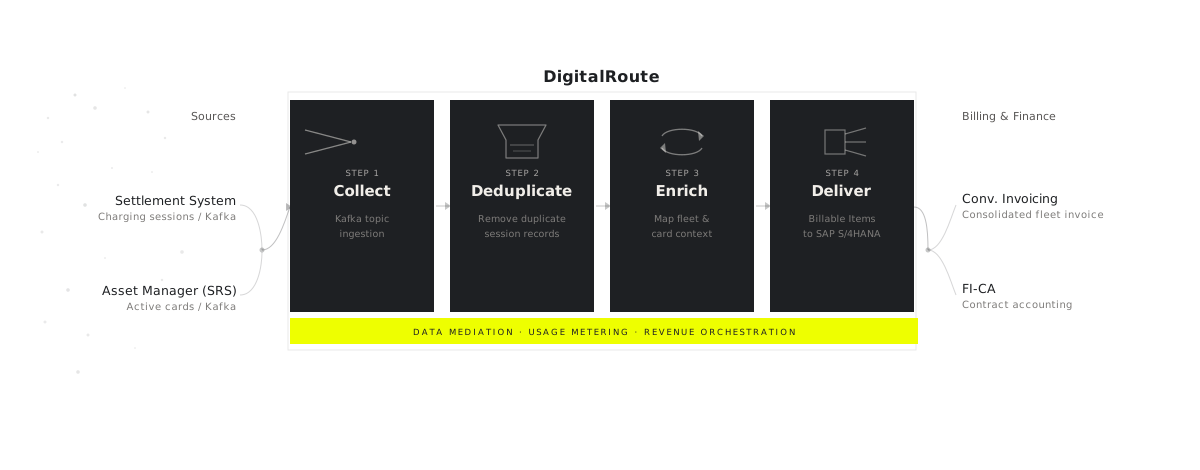
UsageCloud™ Private was deployed as the central data processing layer between the network’s raw charging data and SAP S/4HANA — collecting session events and card asset data from Kafka, deduplicating records, and converting them into Billable Items for consolidated fleet invoicing.
For the first time, fleet customers received a single invoice combining their card subscription fees and all charging session charges — regardless of how many drivers, vehicles, or charging points were involved. The billing run that had required manual reconciliation was now fully automated.
The B2B foundation went live in three months. With the mediation layer in place, the path to B2C consumer billing and roaming partner settlement was no longer a re-architecture — it was configuration.
The Outcome
300K+
Charging points covered
Session data collected and billed across the full network footprint — 33 countries, all on the same mediation foundation.
3 mo
B2B go-live
Full B2B fleet billing layer deployed and live within a single quarter on RISE with SAP — without disrupting existing operations.
Zero
Data loss
Kafka-native ingestion with automatic retries ensured every charging session was captured and billed — no manual exception handling.
One
Consolidated invoice
Card fees and session charges combined into a single fleet invoice — eliminating the manual reconciliation that had made accurate billing impossible at scale.
The Architecture
Facing a similar challenge?
Talk to us for a walkthrough of how this transformation was done and what it could look like for your business.