
Case Study · Software & Digital Experience
Preventing Revenue Leakage Across a B2B Digital Software Portfolio
Industry
Software & Digital Experience
Size
~30,000 employees
Region
North America
Monetization Model
Usage-Based
About Customer
Use case
Usage Threshold Monitoring & Over-Usage Billing
Transformation
Product Licensing → Consumption-Based Services
Live since
2015
Company
A global leader in digital experience software, providing creative, marketing, and document management tools to enterprises and individuals worldwide. Having successfully transitioned its core product portfolio from perpetual licensing to a subscription and cloud-delivered model, the company needed its B2B billing infrastructure to keep pace — specifically the ability to track how customers consumed software against their entitlements and charge for over-usage.
Situation
The company had already built its own data collection system to track usage across its digital marketing and media product lines. But as the B2B business scaled, the limitations of that system became impossible to ignore. It couldn’t keep up with growing volumes, it was expensive to maintain, and — most critically — it had no way to detect when customers crossed their usage thresholds. Revenue was walking out the door undetected, and the engineering team was spending more time keeping the system alive than improving it.
Challenges
- The homegrown data collection system could not scale. As the B2B product portfolio grew, the system’s inability to handle increasing event volumes became a recurring operational problem with no clean fix in sight.
- Threshold monitoring didn’t exist. Without the ability to detect when a customer crossed their usage entitlement, the company had no mechanism to trigger over-usage charges — a direct, unquantified revenue loss across every B2B contract.
- Maintenance cost was growing faster than value. The custom infrastructure required ongoing engineering effort just to keep running, pulling resources away from product development without delivering meaningful capability improvements.
- New business models required engineering every time. Commercial teams could not introduce new usage-based pricing without a development cycle — making pricing agility impossible at the pace the business needed.
“This solution became critical for implementing tightly controlled usage accounting across all of our B2B offerings.”
– Senior Director, B2B Channel & Enterprise Services · Global Digital Software Company
Why DigitalRoute
Homegrown vs. purpose-built – unscalable data collection replaced with threshold-aware usage metering across B2B product lines
The company needed a platform that could replace a system built for a simpler era — one that brought scalability, threshold intelligence, and audit-grade data traceability without requiring the business to rebuild its billing stack from scratch.
- Threshold alerting built in. The ability to set usage threshold levels and automatically generate alerts was not something the old system could be retrofitted to provide. It needed to be foundational — and it was.
- Business users own the billing rules. The platform allowed commercial and finance teams to define and manage their own usage aggregation logic and billing rules — no engineering ticket required for each new pricing model or threshold configuration.
- Full data traceability and audit controls. For a B2B business billing on consumption, every charge needs to be defensible. The platform’s end-to-end traceability gave finance complete confidence in the numbers and a clean audit trail for every invoice.
The Solution
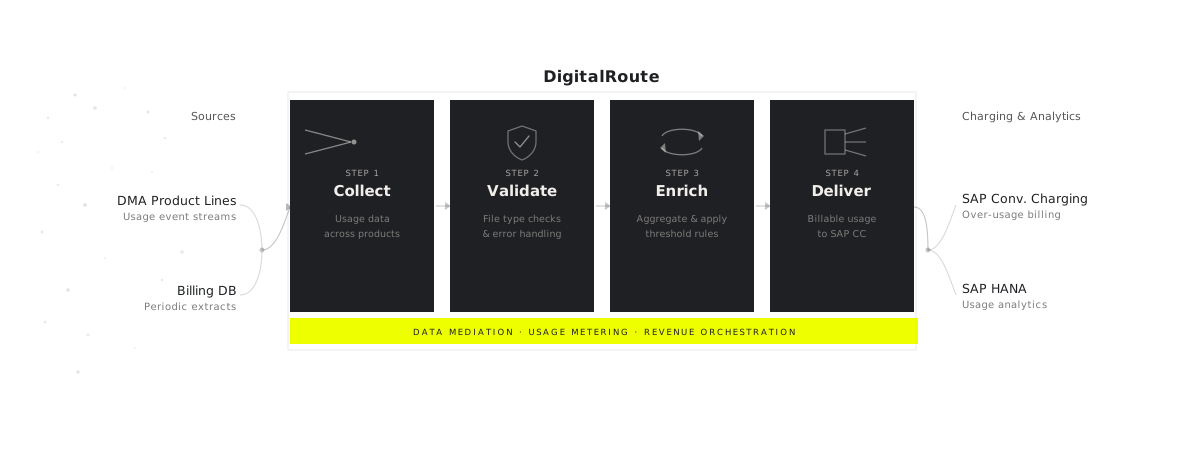
Usage metering layer between digital marketing product lines and SAP Convergent Charging
MediationZone was deployed as the usage accounting layer across all B2B product lines — collecting usage data from each product environment, validating and normalising it, applying threshold logic, and delivering billable usage to SAP Convergent Charging.
For the first time, the company had a system that could detect when a customer reached their entitlement limit and act on it — triggering alerts and generating the over-usage charges that had previously gone uncaptured. Revenue leakage that had been invisible became a controllable, billable event.
Pricing agility followed. With billing rules owned by commercial teams rather than engineering, new usage tiers and threshold configurations could be deployed through configuration — removing the development bottleneck that had made pricing changes slow and expensive.
The Outcome
Revenue leakage eliminated
Over-usage charges that had gone uncaptured across every B2B contract were now systematically detected, triggered, and billed — closing a previously invisible revenue gap.
Tightly controlled usage accounting
End-to-end data traceability and strict audit controls gave finance complete confidence in every usage-based charge across the B2B portfolio.
Pricing agility without engineering
New usage tiers and threshold configurations deployed through business-owned rules — commercial teams no longer dependent on engineering to launch or adjust pricing models.
The Architecture
Facing a similar challenge?
Talk to us for a walkthrough of how this transformation was done and what it could look like for your business.