
Case Study · Travel Technology
Replacing a 30-Year-Old Billing Infrastructure Across a Global Travel Distribution Platform
Industry
Travel Technology
Size
~4,000 employees
Region
Global
Monetization Model
Transaction-Based
About Customer
Use case
Legacy Billing Infrastructure Modernization
Transformation
Siloed Legacy Systems → Unified Data Mediation PlatformFragmented Manual Billing → Cloud-Native Pre-Rating Pipeline
Company
A global travel technology company powering bookings for hundreds of thousands of travel suppliers worldwide — connecting airlines, hotels, rail and car rental companies with travel agencies and online booking platforms. Operating across more than 165 countries, the company had spent decades running the infrastructure that underpins the global travel industry, processing an enormous volume of transactions daily through a next-generation travel marketplace.
Situation
The billing systems at the core of the company’s operations were more than 30 years old. Built for a simpler era — when there were hundreds of travel products rather than tens of thousands — they had been held together through decades of patches and workarounds. The data they produced was inconsistent, the processes around them were heavily manual, and the siloed architecture made it nearly impossible to introduce change without risk. Replacing them was not optional. The question was how to do it without disrupting a business that ran on them every day.
Challenges
- Decades of accumulated complexity had made the legacy systems difficult and expensive to maintain. Every change required deep specialist knowledge, and the risk of regression was high enough that teams were reluctant to touch anything.
- Siloed data systems produced inconsistent outputs. Without a unified processing layer, reconciling data across systems was a manual exercise — slowing billing cycles and introducing opportunities for error.
- The existing infrastructure could not adapt to changing business needs. With travel product complexity growing — from roughly 500 options in 2010 to an estimated 10,000 by 2024 — the billing architecture needed to scale and flex alongside the business.
- High compliance and resiliency requirements left no margin for error. Any replacement solution had to meet the same standards the legacy system had been held to for decades — while also being easier to operate and extend.
“It’s not every decade that you get to replace and kick a 30-year-old system to the curb. The beginning of many more benefits through DigitalRoute execution.”
– EVP & Chief Information Officer · Global Travel Technology Company
Why DigitalRoute
Legacy vs. modern – 30-year-old siloed billing systems replaced with a flexible, well-documented Linux-based mediation platform
The replacement needed to be proven, flexible enough to match the existing system’s behaviour precisely, and modern enough to make future change genuinely simple. A bespoke build would have recreated the same problem in a new codebase. A standard platform with deep data processing capability was the only path forward.
- Able to reproduce existing processes exactly. The platform could mirror Travelport’s legacy data flows and demonstrate parity in a proof of concept — giving the team confidence that migration would not break downstream billing before a single line went live.
- Modern, well-documented, and maintainable. The replacement architecture was built to be understood and extended by future teams — not locked in the heads of a shrinking group of legacy specialists. Documentation was treated as a first-class deliverable throughout.
- Comparison dashboards for controlled migration. Built-in tooling allowed the Travelport team to run new and legacy processes in parallel and compare outputs — making testing systematic and building organizational trust in the new platform before full cutover.
The Solution
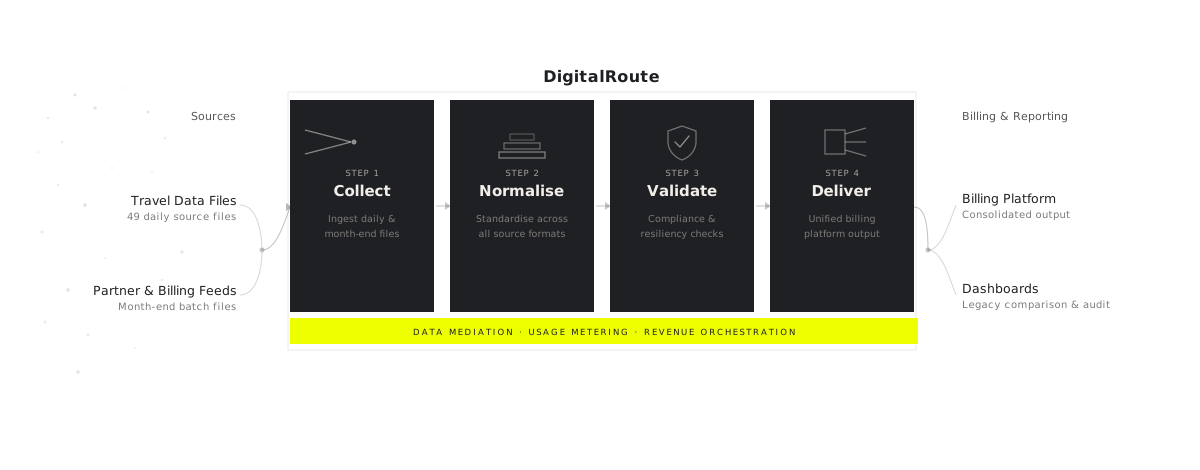
Data normalization layer replacing siloed legacy billing systems with a unified Linux-based Mediation Zone platform
MediationZone was deployed on a Linux-based architecture to replace the legacy billing infrastructure — consolidating siloed systems into a single, unified processing platform. Using a Scaled Agile approach, functionality was migrated incrementally: existing workflows were reproduced in the new platform, validated against the legacy output, and progressively cut over.
The initial implementation processed 49 source files daily — plus additional end-of-month files — completing the full daily run in under one hour. What had previously required manual intervention and lengthy processing windows became a reliable, automated cycle with consistent, auditable output.
The new platform gave the business something the legacy systems had never offered: the ability to change. New data flows could be configured without deep specialist knowledge, tested safely against known baselines, and deployed without the fear of cascading failure that had made the old architecture so difficult to touch.engineering, shortening the time from commercial decision to live billing cycle.
The Outcome
<1 hr
Daily processing
49 source files processed end-to-end in under one hour — a run that previously required manual intervention and extended processing windows.
30 yr
Legacy retired
Three decades of accumulated billing infrastructure replaced with a modern, maintainable, Linux-based mediation platform.
One
Unified platform
Siloed legacy systems consolidated into a single data processing layer — eliminating the manual reconciliation that complexity had made unavoidable.
Full
Audit trail
End-to-end data traceability and comprehensive documentation — built in from day one to support compliance, testing, and future team knowledge transfer.
The Architecture
Facing a similar challenge?
Talk to us for a walkthrough of how this transformation was done and what it could look like for your business.