
Case Study · Consumer Goods
Automating Distributor Reimbursement Across a Complex Multi-Source Ecosystem to Achieve 100% Billing Accuracy
Industry
Consumer Goods
Size
~86,000 employees
Region
North America
Monetization Model
Volume-Based
About Customer
Use case
Distributor Reimbursement Automation
Transformation
Manual Reimbursement Processes → Automated Distributor Settlement Platform
Company
A global beverage corporation operating across the Americas, with one of the world’s most extensive distributor ecosystems. The company manages complex reimbursement relationships with thousands of distributors — covering beverage volumes purchased, equipment leased, and point-of-sale goods — making accurate, automated financial settlement a critical operational requirement at scale.
Situation
Distributor reimbursements were processed manually across bespoke legacy systems — each operating in isolation and producing inconsistent outputs. Data arrived from entirely separate platforms: equipment lease records from JD Edwards, volume data from Teradata, and vendor contract hierarchies from SAP. With no unified layer to consolidate and validate this information, the reimbursement process was slow, error-prone, and opaque. Finance teams had limited visibility into what was being paid, to whom, and why — and the growing complexity of distributor contract structures was pushing the manual model beyond its limits.
Challenges
- Manual processes across fragmented legacy systems created persistent errors in reimbursement calculations — eroding distributor trust and creating significant back-office overhead to identify and correct discrepancies.
- Data arrived from multiple disconnected sources — beverage volumes from Teradata, equipment leases from JD Edwards, and contract terms from SAP SOM — with no automated way to consolidate, cleanse, and cross-reference these inputs before financial calculation.
- No transparency over the end-to-end reimbursement chain. Finance could not easily trace a payment back through the calculation logic to its source data — making audit, dispute resolution, and operational reporting extremely time-consuming.
- Bespoke legacy systems could not accommodate increasing contract complexity or scale alongside the distributor ecosystem — and replacing them required a solution built for both current needs and future growth.
Why DigitalRoute
Manual vs. automated – error-prone legacy reimbursement processes replaced with a real-time data mediation layer for SAP Hybris Billing
The reimbursement chain depended on combining high-volume data from systems that had never been designed to talk to each other. Generic ETL tooling could normalize the formats, but could not perform the real-time validation, aggregation, and contract-aware enrichment that finance-grade reimbursement accuracy required. MediationZone was selected as the consolidation layer between the source systems and SAP Convergent Charging — specifically for its ability to handle the data volume, apply contract logic, and produce clean Consumption Items that the charging engine could process without error.
- Real-time collection and validation across all data sources. MediationZone ingested data from JD Edwards, Teradata, and additional vendor sources simultaneously — validating and cleansing each record before it reached the financial calculation layer, eliminating the root cause of downstream errors.
- Contract-aware aggregation per vendor. The platform aggregated volume per vendor based on Master Contract information pulled directly from SAP SOM — ensuring every reimbursement calculation was grounded in the correct contractual terms rather than derived from approximations.
- On-demand reprocessing capability. The architecture retained the ability to reprocess data on demand — giving operations teams a controlled mechanism for handling exceptions and corrections without disrupting the automated flow for all other distributors.
The Solution
Distributor data consolidation layer between disparate source systems and SAP Convergent Charging
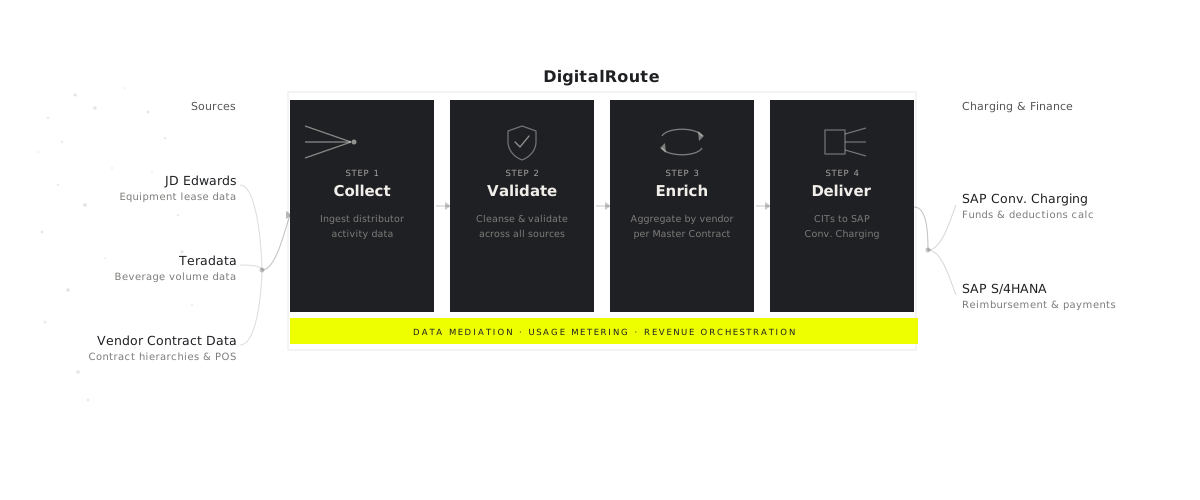
MediationZone was deployed as the consolidation layer between the company’s distributor data sources and SAP Hybris Billing. The platform collected equipment lease data from JD Edwards, volume data from Teradata, and vendor contract hierarchy information from additional sources — validating and cleansing records in real time before aggregating them into Consumption Items (CITs) structured for SAP Convergent Charging.
SAP Convergent Charging applied the funds and deductions calculation logic against Master Contracts from SAP SOM — determining the precise reimbursement owed to each distributor based on volumes sold, equipment leased, and contractual terms. The resulting Billable Items (BITs) flowed into SAP S/4HANA, where Hybris Billing Invoicing generated reimbursement statements and the Customer Financial module processed outgoing payments.
The outcome was a fully automated, end-to-end reimbursement pipeline — from raw distributor activity data to outgoing payment — with complete traceability at every step and the flexibility to handle exceptions on demand without manual intervention across the wider distributor base.
The Outcome
100%
Reimbursement accuracy
Billing and reimbursement events tracked with 100% accuracy — eliminating the calculation errors that had characterized the manual process.
Full
Transparency
End-to-end visibility over the reimbursement chain — from source data through contract calculation to outgoing payment — across the entire distributor ecosystem.
Zero
Manual errors
Automated consolidation and validation of distributor data replaced error-prone manual processes, freeing finance teams from back-office reconciliation overhead.
On-demand
Reprocessing
Exceptions and corrections handled via on-demand data reprocessing — without disrupting automated settlement for the rest of the distributor base.
The Architecture
Facing a similar challenge?
Talk to us for a walkthrough of how this transformation was done and what it could look like for your business.