
Case Study · Media Technology
The Build-vs-Buy Decision That Put Cloud Revenue Back on Track
Industry
Media Technology
Size
~200 employees
Region
Europe
Monetization Model
Consumption-Based
About Customer
Use case
Consumption Metering & Cloud Billing Transition
Transformation
Self-Built Metering Layer → UsageCloud™ + Workday
Company
A European software company delivering editorial and publishing platforms for media organisations. The company is moving from on-premise software delivery to a multi-cloud model — a transition that changes not just the technical architecture but the commercial one. On-premise software is sold as a licence. Cloud delivery means consumption, and consumption means platform usage has to be measured before it can be charged. The company’s cloud re-architecture was progressing; the commercial infrastructure needed to catch up.
Situation
The move to cloud delivery created an immediate revenue problem: to bill customers for what they use, the company needed to collect, validate, and meter platform consumption before records could flow to Workday for invoicing. Without a metering layer, cloud infrastructure could run but not generate revenue — every month deployed without billing was a month of cloud investment with no commercial recovery. The company began building a metering solution internally. They built deduplication logic, validation rules, and began mapping the edge cases: reprocessing failed batches, managing replay windows, maintaining an audit trail. Each completed piece revealed another. The build was accumulating engineering attention without a clear ship date. The decision was made to stop building and buy instead.
Challenges
- Cloud infrastructure running ahead of billing — every month the platform was live but unmetered was a month of cloud spend without commercial recovery. The billing layer was on the critical path to revenue.
- The internal build kept expanding — deduplication, validation, replay, audit trails: each edge case uncovered another requirement that production usage billing actually demands. The scope kept growing.
- Engineering attention at risk — developer cycles going into the metering build were cycles not going into the publishing platform itself. The longer the build continued, the more the core product team was carrying a billing problem.
- Workday was already in place — any solution had to slot cleanly in front of the existing invoicing system without replacing downstream infrastructure or forcing a Workday reconfiguration.
Why DigitalRoute
Self-built metering abandoned — purpose-built collection and metering layer configured in place
The build-vs-buy decision came down to a simple calculation: every month without a metering layer was a month of cloud investment without new revenue. UsageCloud had already solved the problems the internal build was accumulating — and it could be configured against live platform data in a matter of weeks.
- Purpose-built for usage billing edge cases. Deduplication, validation, replay windows, audit trails — all the requirements the internal build was discovering are solved problems inside UsageCloud. Nothing had to be built from scratch.
- Approximately two weeks to first billing run. A developer had UsageCloud running against live platform data within roughly two weeks of starting configuration — not months of internal engineering.
- Configuration without code. Pricing model changes — new consumption tiers, adjusted rates — flow through the mediation layer without requiring a software release from the publishing platform team.
- Clean fit in front of Workday. UsageCloud™ slots directly between platform consumption events and Workday invoicing, without requiring any reconfiguration of the downstream billing system already in place.
The Solution
UsageCloud™ as the metering layer — from platform events to Workday invoicing
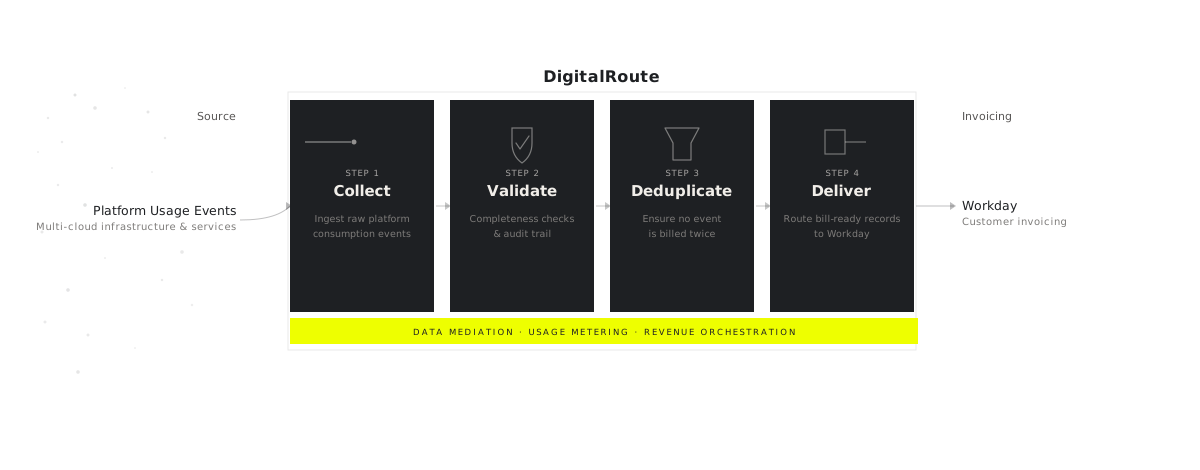
UsageCloud™ was deployed as the metering layer between the company’s multi-cloud platform and Workday. Platform consumption events are ingested into the pipeline, validated for completeness, deduplicated to ensure no event reaches Workday twice, and delivered as bill-ready records for customer invoicing. The layer replaces everything that would have been built internally — deduplication, validation, audit trail, error routing, and replay — in a single configured platform.
The build-vs-buy decision came down to recognising scope. The internal build had started with deduplication and validation, and each edge case revealed another requirement that production usage billing actually demands. UsageCloud™ had all of it already. A developer had it running against live platform data within approximately two weeks of starting configuration — not months of continued internal engineering.
With billing off the critical path, the cloud re-architecture can proceed on its own timeline. The architecture is also building toward two further capabilities: cost-to-serve attribution at the account level, giving the company profitability visibility by customer for the first time; and customer-facing consumption dashboards, enabling media organisation clients to monitor their own platform usage as a FinOps self-service feature.
The Outcome
~2 weeks
Time to first billing run
A developer had UsageCloud™ running against live platform data within approximately two weeks of starting configuration.
Zero
Release cycles per pricing change
Consumption tiers and rate updates are configured in the mediation layer — no software release from the publishing platform team required.
Unblocked
Critical path cleared
Billing infrastructure no longer blocks the cloud re-architecture timeline. Cloud investment converts to revenue without waiting on an internal metering build.
The Architecture
Facing a similar challenge?
Talk to us for a walkthrough of how this transformation was done and what it could look like for your business.