
Case Study · Data Intelligence & B2B Services
Modernizing B2B Data Intelligence Billing on a Cloud-Native Stack
Industry
Data Intelligence & B2B Services
Size
Mid-Market Enterprise
Region
France & Benelux (EMEA)
Monetization Model
Subscription + Usage-Based
About Customer
Use case
Evolve Complex Subscription Models for B2B Data Services
Transformation
Fragmented Manual Billing → Cloud-Native Pre-Rating Pipeline
Company
A B2B data intelligence company and exclusive partner of Dun & Bradstreet for France, Benelux, and North Africa. Serving 100,000+ organisations with credit risk, compliance, and business analytics data drawn from 500 million companies worldwide, the company had built a growing portfolio of Enterprise Data Intelligence subscription services — each with increasingly complex pricing and billing requirements.
Situation
As the company’s portfolio of Enterprise Data Intelligence products grew across France and Benelux, the billing infrastructure beneath them had not kept pace. Customer data lived in Salesforce, billing ran in Zuora, and raw usage files arrived separately via file transfer — with no system reliably connecting them.
Managing subscription models that varied by contract, by product, and by region required a level of pre-rating and orchestration that the existing setup could not provide. The gap between commercial ambition and operational capability was becoming visible in revenue leakage and delayed launches.
Challenges
- Billing processes operated in silos. Salesforce CRM, Zuora billing, and raw usage data were disconnected, requiring manual effort to reconcile them and increasing the risk of billing errors.
- Complex subscription models required pre-rating per contract — applying specific pricing rules to usage data before it reached Zuora. No existing system could handle this without custom engineering for each contract type.
- Adding new services or modifying pricing models required engineering involvement each time, slowing time to market and making the company less agile in responding to commercial opportunities.
- Without a unified audit trail from usage to invoice, revenue leakage was occurring from untracked or incorrectly rated consumption — difficult to quantify and harder to recover.
Why DigitalRoute
Consolidate vs. build – fragmented billing silos replaced with a cloud-native PaaS mediation layer
The company needed a consolidation layer that could connect Salesforce, Zuora, and raw usage data without requiring internal infrastructure investment. A PaaS solution deployed on AWS meant the capability could be live without the cost and complexity of hosting it internally.
- Pre-built connectors for Salesforce and Zuora. Native integrations to both systems removed the need for custom development at either end of the pipeline — the mediation layer connected to the CRM and billing system without bespoke connector work.
- Pure PaaS on AWS — zero internal infrastructure. Deployed as a Platform-as-a-Service on Amazon Web Services, the solution required no internal IT or network infrastructure investment — a production-grade mediation platform without the overhead of hosting it internally.
- Per-contract pre-rating through configuration. Complex subscription pricing logic — varying by contract, product, and region — applied through configuration rather than custom code. New pricing models no longer required engineering projects to implement.
The Solution
Pre-rating and orchestration layer between usage sources, Salesforce CRM, and Zuora billing
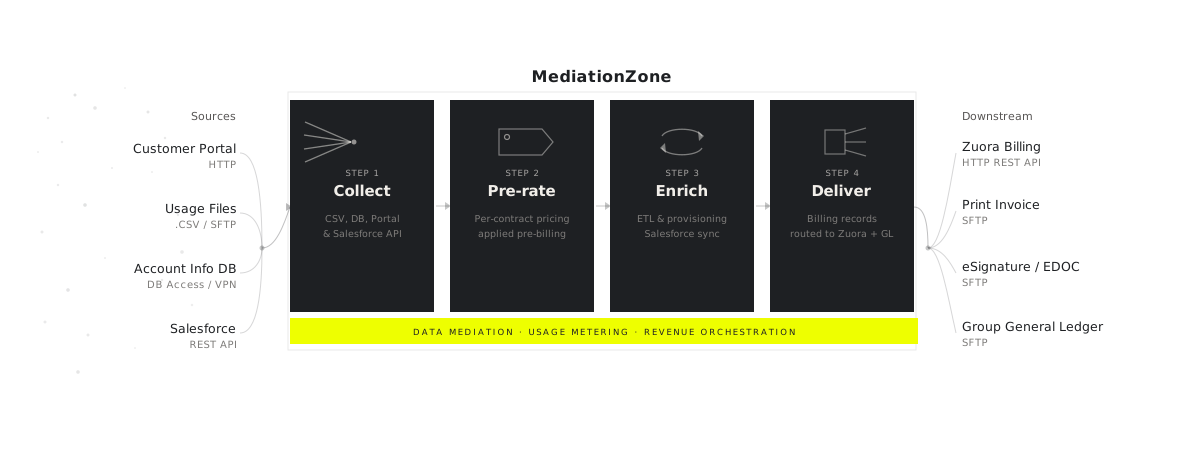
Working with DigitalRoute, the company deployed MediationZone on AWS as a pure PaaS consolidation layer — ingesting CSV usage files via SFTP, account data from its database, and CRM records from Salesforce, without requiring any internal IT or network infrastructure.
The pre-rating layer applied per-contract pricing logic before routing billing-ready records to Zuora, while Salesforce account data was synchronised automatically. Downstream, processed data flowed to invoicing, eSignature, and the Group General Ledger — connecting billing through to financial documentation without manual intervention.
New services could be onboarded through configuration rather than custom engineering, shortening the time from commercial decision to live billing cycle.
The Outcome
One consolidated cloud pipeline
Salesforce, Zuora, usage files, and the Group General Ledger all connected through a single AWS-hosted layer, replacing fragmented manual processes across France and Benelux.
Per-contract pre-rating, through configuration
Complex subscription pricing rules applied per contract without custom engineering — making new pricing models commercially viable to launch without an IT project.
New services launched faster
New data products onboarded through configuration, not engineering projects — shortening the time from commercial decision to live billing cycle.
The Architecture
Facing a similar challenge?
Talk to us for a walkthrough of how this transformation was done and what it could look like for your business.