
Case Study · Enterprise Software & Cloud Platform
Monetizing a Global Cloud Platform with Pay-Per-Use Credit Billing at Scale
Industry
Enterprise Software & Cloud Platform
Size
~105,000 employees
Region
Global (180 countries)
Monetization Model
Pay-Per-Use (Cloud Credits)
About Customer
Use case
Monetize Cloud Platform Services via Pay-Per-Use Credit Model
Transformation
Subscription / Perpetual → Pay-Per-Use Cloud Credits
Live since
2019
Company
One of the world’s largest enterprise software companies, serving more than 400,000 enterprise customers across every major industry and region. With a portfolio spanning ERP, data management, analytics, and cloud platform services, the company was expanding its own cloud infrastructure into a consumption-based commercial model — and needed to monetize it with the same precision it helped its customers achieve.
Situation
As the company accelerated its cloud platform strategy, a fundamental question emerged: how do you charge customers fairly for platform services when usage data lives at the infrastructure level, arrives in raw formats, and flows from dozens of different service types simultaneously? The shift from subscription and perpetual licensing to a pay-per-use credit model required a new metering capability the existing architecture could not provide — one that could attribute infrastructure consumption to the right customer account, at the right granularity, in real time.
Challenges
- Usage data arrived at the infrastructure level — raw bytes, timestamps, service and plan identifiers — with no commercial context attached. Transforming it into billable records required enrichment with account master data that lived in a completely separate system.
- The same infrastructure telemetry served two different commercial models: SaaS customers who paid a flat fee and PAYG customers who paid per consumption. Separating them accurately from the same data stream was non-trivial and critical to billing accuracy.
- Communication timeouts and system retries meant the same usage event could arrive multiple times. Without strict deduplication, customers would be charged more than once for the same consumption event.
- The platform was already processing 6 million transactions per day — and growing fast. The metering layer needed to be designed to scale ahead of demand, not catch up to it.
Why DigitalRoute
Subscription vs. metered – flat licensing replaced with a real-time pay-per-use cloud credit metering layer
The company built its own cloud platform credit billing on UsageCloud — a decision that reflects both the platform’s fit for the use case and the recognition that even a software company of this scale benefits from purpose-built mediation over custom infrastructure.
- Pre-integrated with SAP BRIM for fast time-to-market. SAP CM’s pre-built integration with SAP BRIM meant the metering layer connected directly to the billing and charging systems without custom connector work — a stated requirement for the project.
- Configuration-based enrichment for complex usage attributes. Each service type had different usage attributes, pricing logic, and charging rules. Configuration-based enrichment — not code changes — was the only practical way to handle this diversity at platform scale.
- Proven deduplication at high volume. The billing-exactly-once requirement at 6M+ daily transactions is a non-negotiable standard. DigitalRoute’s deduplication engine was chosen specifically for its proven reliability at this scale.
The Solution
Metering and mediation layer between cloud service adapters and SAP Converged Charging
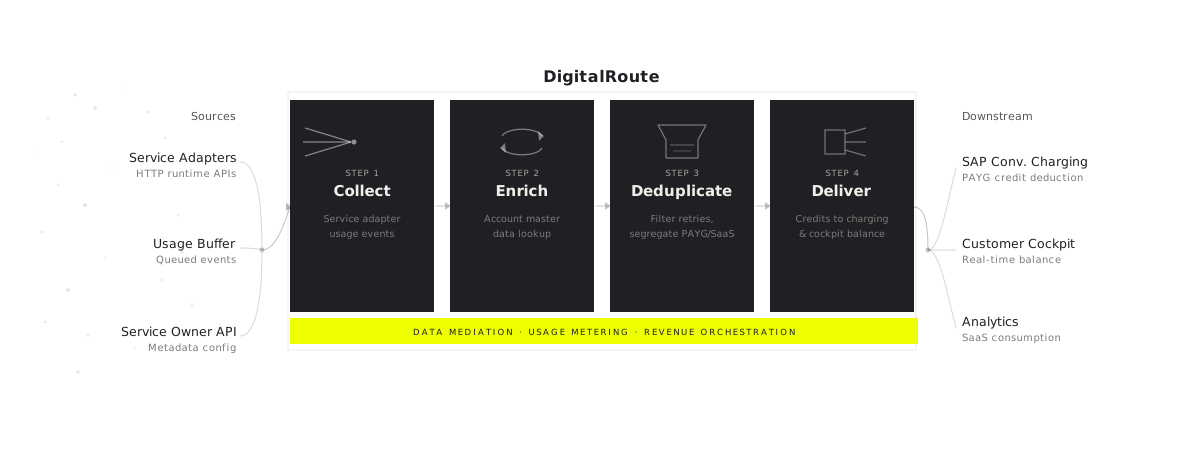
Working with DigitalRoute, the company built the metering and mediation layer for its cloud platform billing. UsageCloud ingested raw usage events from dozens of cloud service adapters via HTTP, enriched them with Global Account and sub-account master data, and aggregated consumption per customer and service type before any credit deduction was triggered.
The segregation logic — determining which usage was billable and which was not, based on the customer’s commercial model — was handled entirely through configuration. PAYG customers had their consumption routed to SAP Converged Charging for cloud credit deduction. SaaS customers had their consumption routed to consumption analytics instead. Same data stream, two completely different downstream paths — without a single line of custom code.
For the first time, customers could see their real-time cloud credit balance in a self-service cockpit — connected directly to the metering pipeline. Usage, billing items, and remaining credit were visible in real time, not as a batch report after the fact.
The Outcome
6M+
Transactions per day
DigitalRoute processed 6M+ daily cloud service transactions at implementation — with architecture designed to double capacity as the platform scaled.
One
Stream, two models
The same infrastructure telemetry was accurately split into PAYG (chargeable) and SaaS (non-chargeable) usage — making cost attribution possible without separate data pipelines.
Zero
Duplicate charges
Communication retries and timeouts filtered at the mediation layer — guaranteeing that no customer was ever charged twice for the same consumption event.
Live
Credit visibility
Customers could see their real-time cloud credit balance in a self-service cockpit — connected directly to the metering pipeline, not a batch report.
The Architecture
Facing a similar challenge?
Talk to us for a walkthrough of how this transformation was done and what it could look like for your business.