
Case Study · Travel & Online Marketplace
Replacing Legacy Integration to Achieve Finance-Grade Transaction Accuracy at Global Scale
Industry
Travel & Online Marketplace
Size
Mid-Market Enterprise
Region
France & Benelux (EMEA)
Monetization Model
Subscription + Usage-Based
About Customer
Use case
Automate Enterprise B2B Billing and Cash Reconciliation
Transformation
Mulesoft Integration → Finance-Grade Mediation
Live since
2024
Company
One of the world’s largest online travel platforms, connecting hundreds of millions of customers with accommodation, flights, and car rentals across 220+ countries and territories. Operating through 3.4 million listed properties and processing transactions in over 40 languages, the company’s financial operations run at a scale where accuracy and traceability are not just operational requirements — they are regulatory ones.
Situation
The company was executing a major financial transformation — migrating its Order-to-Cash architecture to SAP S/4HANA. At the centre of that migration was a critical problem: the existing integration layer, built on Mulesoft, was no longer fit for purpose. It could not validate data quality before transactions reached the financial ledger, could not trace a reservation end-to-end, and could not meet the SOX compliance obligations that came with operating at this scale. The migration was the opportunity to fix it — but only if the right foundation was put in place first.
Challenges
- Double invoicing and missing invoices were occurring regularly — direct financial losses that were difficult to detect, harder to trace, and damaging to property and partner relationships.
- Reservation and payment events arrived from different systems at different times in unpredictable order. There was no mechanism to hold and correlate them before posting to the financial ledger.
- The Mulesoft integration provided no end-to-end traceability — the status of any given reservation could not be reliably determined, making dispute resolution slow and error recovery manual.
- SOX compliance required complete, auditable traceability from transaction to ledger posting. The existing architecture could not demonstrate this.
Why DigitalRoute
Legacy vs. purpose-built – Mulesoft integration replaced with a finance-grade correlation and validation layer
The company needed to replace Mulesoft with something that could enforce completeness validation before any transaction touched the accounting ledger — not just route events, but guarantee that every reservation was matched to a payment before posting. That is a fundamentally different architectural requirement from generic integration.
- Purpose-built for financial-grade data quality. DigitalRoute was selected specifically because it could enforce completeness validation before posting. Every transaction reaching S/4HANA has been validated and correlated — not what Mulesoft was designed to do.
- 1-year correlation window at 1.5 billion events. Reservations and payments arrive asynchronously — sometimes months apart. The ability to hold and match events across a 1-year window at this volume was a non-negotiable requirement no generic integration tool could satisfy.
- Native SAP S/4HANA integration. With SAP MaxAttention involved in the blueprint phase, DigitalRoute’s native integration with SAP Convergent Invoicing, FICA, and HANA removed integration risk at the most critical point in the transformation.
The Solution
Correlation and validation layer between the order and payment platforms and SAP S/4HANA
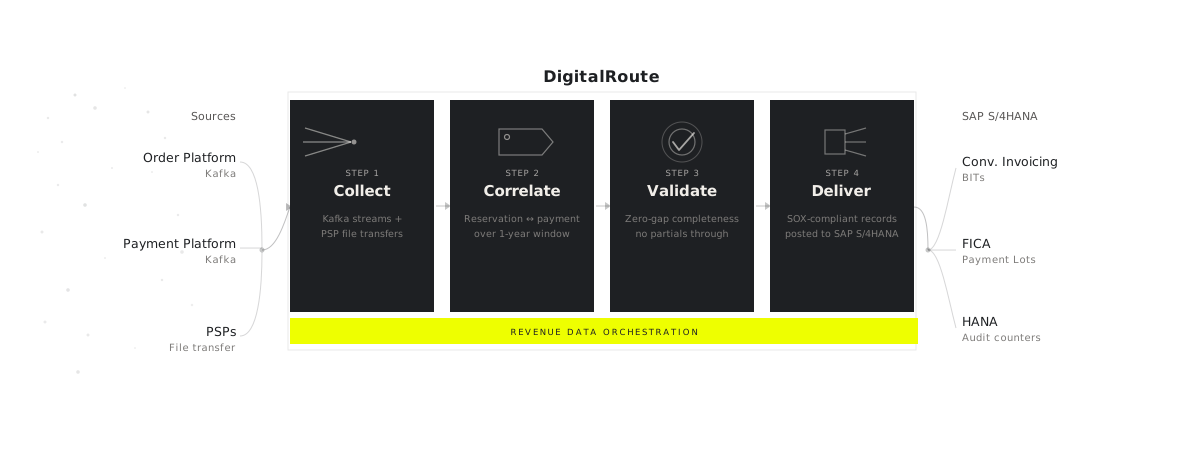
DigitalRoute replaced Mulesoft as the validation and aggregation layer between the company’s upstream platforms and SAP S/4HANA — ingesting reservation orders from Kafka, payment events from Kafka, and settlement data from payment service providers simultaneously.
Within a 1-year correlation window, DigitalRoute matched each reservation — hotel, flight, or car — with its corresponding payment to produce complete, validated business transactions. Only after this match was confirmed did data flow downstream to SAP Convergent Invoicing and FICA.
The result was a financially clean pipeline. Double invoicing became structurally impossible. Missing invoices were caught before they occurred. Every transaction carried a full audit trail — satisfying SOX requirements and giving finance the traceability it needed to close the books with confidence.
The Outcome
1.5B
Orders matched per year
DigitalRoute processes 1.5 billion reservation orders annually through a 1-year correlation window, matching each booking to its payment before any data reaches SAP S/4HANA.
Zero
Double invoicing
Completeness validation made double invoicing structurally impossible — protecting revenue and eliminating a direct source of property partner disputes.
1 year
Correlation window
Reservation and payment events arriving months apart are held and matched within a 1-year window — handling the async reality of a global travel marketplace.
Full
SOX traceability
Every transaction carries a complete audit trail from source event to ledger posting — satisfying compliance requirements and enabling confident financial reporting.
The Architecture
Facing a similar challenge?
Talk to us for a walkthrough of how this transformation was done and what it could look like for your business.