Case Study · Enterprise Technology
Transitioning From Hardware Sales to Printing as a Service With Per-Page Usage Billing Across Enterprise Accounts
Industry
Enterprise Technology
Size
~10,000 employees
Region
Global
Monetization Model
Usage-Based
About Customer
Use case
Hardware-to-Service Business Model Transition
Transformation
Hardware Sales Model → Printing as a Service
Company
A global manufacturer of laser printers and imaging products serving enterprise customers across industries worldwide. Facing margin pressure on hardware sales, the company made a strategic decision to evolve its business model — shifting from selling devices as one-off capital expenditures to offering Printing as a Service, where enterprise customers pay based on actual pages printed. To do this at scale required a usage metering infrastructure capable of capturing granular device data, binding it to customer contracts, and feeding both billing and operational intelligence systems.
Situation
The company’s existing architecture had no mechanism for capturing and processing per-page usage data at the device level. Usage information lived in a Siebel database — disconnected from the SAP Convergent Charging system that held customer contracts and billing logic. There was no automated layer to bridge these two systems, apply contract terms to usage events, or route processed data downstream for invoicing. Without this, a usage-based service model was operationally impossible. At the same time, the company wanted to use the same data stream for predictive maintenance — proactively identifying when toner was low or a device needed service — requiring a single mediation layer that could serve two entirely different downstream purposes.
Challenges
- No infrastructure to support a per-page billing model. Usage data from physical printers was captured in Siebel but had no automated path to the SAP billing system — making usage-based invoicing manually unscalable across an enterprise customer base.
- Usage data needed to be bound to specific individuals and departments within each customer’s organization — not just aggregated at account level — to enable accurate cost allocation and internal transparency for customers.
- The same usage data stream had to serve two distinct purposes: financial billing and operational intelligence. A solution that handled only one would leave the predictive maintenance use case — toner status, device health — without a data feed.
- Exception handling and data reprocessing were required to ensure no usage events were lost or incorrectly billed. Any gap in the pipeline would translate directly into revenue leakage or customer disputes.
Why DigitalRoute
CapEx vs. OpEx – one-time hardware transactions replaced with a per-page usage billing layer bridging Siebel and SAP Convergent Charging
Enabling a per-page service model required a convergent data integration layer — one that could simultaneously pull from the Siebel usage database, enrich records with contract data from SAP Convergent Charging, and deliver structured output to both the billing engine and the analytics layer. No general-purpose integration tool could handle the combination of real-time device data, contract-aware enrichment, exception recovery, and dual-purpose output routing that the architecture required.
- Granular device-level usage capture. MediationZone collected meter updates from each printer through Siebel, archiving raw data immediately for auditability and validating records before they entered the billing pipeline — ensuring every page printed was accounted for.
- Contract-aware enrichment via SAP CC web services. The platform queried SAP Convergent Charging in real time to retrieve customer contract and binding information — enabling usage records to be correctly attributed to specific accounts, departments, and contract terms before aggregation.
- Dual-purpose output for billing and predictive intelligence. The same mediation pipeline that produced billable usage records also routed aggregated device data to the analytics layer — enabling toner status prediction and device health monitoring without duplicating the data collection infrastructure.
The Solution
Usage metering layer between printer meter data and SAP billing for per-page Printing as a Service
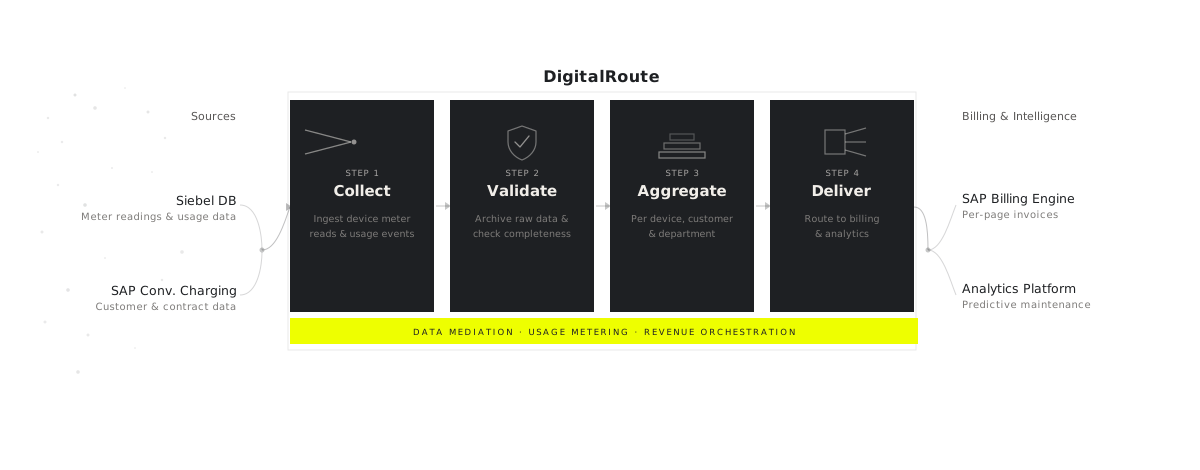
MediationZone was deployed as the convergent data integration layer between the company’s usage infrastructure and its SAP billing ecosystem. The platform collected meter readings and usage data from the Siebel database — archiving raw records immediately for auditability — then validated each record for accuracy and completeness. Web service queries to SAP Convergent Charging retrieved the customer contract and binding data needed to enrich usage events with the correct business context.
Enriched records were aggregated by device, customer, and department before being formatted and delivered as structured Consumption Items to the billing engine. Failed records were routed to an exception queue with an automatic repoll mechanism, ensuring no usage events were lost from the billing cycle.
The same aggregated data stream was simultaneously delivered to a statistical analytics layer — powering predictive maintenance capabilities including proactive toner status monitoring and device health tracking. The result was a single mediation infrastructure serving both the billing system and the operational intelligence platform, underpinning the company’s Printing as a Service proposition end to end.
The Outcome
Per-page
Billing accuracy
Granular per-page usage tracked at device level and correctly attributed to customer contracts — enabling accurate usage-based invoicing at enterprise scale.
Dept-level
Cost transparency
Usage data bound to specific individuals and departments within each customer organization — enabling precise internal cost allocation for enterprise accounts.
Proactive
Predictive maintenance
Toner status and device health monitored from the same data stream as billing — maximizing asset availability and reducing unplanned service calls.
Zero loss
Revenue leakage
Automatic exception handling and data repoll ensured every usage event was captured and billed — eliminating the gaps that manual processes could not prevent.
The Architecture
Facing a similar challenge?
Talk to us for a walkthrough of how this transformation was done and what it could look like for your business.